
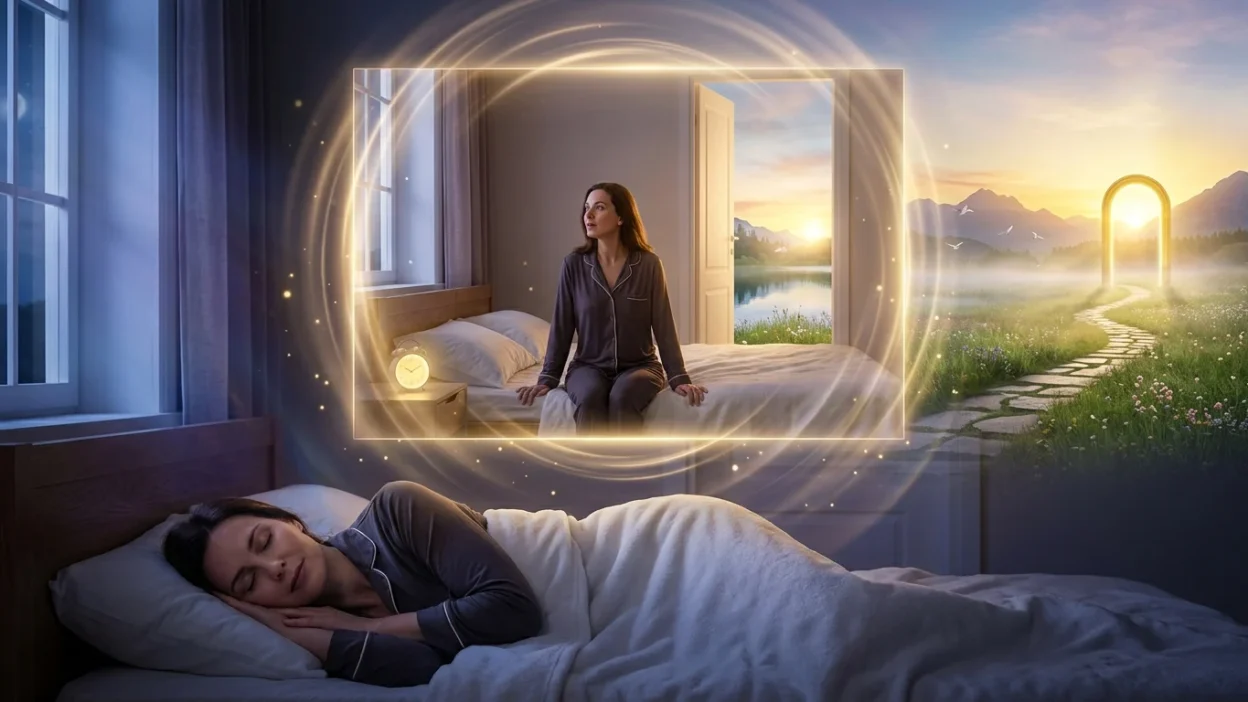
A false awakening is a strange dream experience where you believe you have woken up, only to discover later that you were still dreaming.
You may dream that you got out of bed, checked your phone, went to work, talked to someone or started your normal morning routine. Everything can seem completely real until you suddenly wake up for real.
Because false awakenings can feel incredibly realistic, they often leave people wondering whether they have a deeper spiritual or psychological meaning.
In dream interpretation, a false awakening may symbolize self-awareness, uncertainty, transition, routine, loss of control, subconscious processing or the feeling that something in your waking life is not quite what it seems.
Quick Answer: What Does a False Awakening Dream Mean?
The false awakening dream meaning often relates to self awareness, uncertainty, routine, emotional transitions, subconscious processing or questioning what is real in your life.
It may happen when your mind is processing stress, major changes, disrupted sleep or unresolved thoughts.
Spiritually, some people interpret false awakenings as a period of heightened awareness or inner exploration. Psychologically, they can occur when the brain is moving between different stages of sleep and wakefulness.
A false awakening does not automatically mean something supernatural is happening.
What Is a False Awakening?
A false awakening happens when you dream that you have woken up even though you are still asleep.
The dream may closely resemble your real environment. You might see your bedroom, get dressed, walk around your home, or begin your daily routine.
Sometimes you experience one false awakening. Other times, you may experience several false awakenings in a row, creating the sensation of waking up repeatedly.
False awakenings can also occur alongside lucid dreams and other unusual dream experiences.
False Awakening Dream Symbolism
Self Awareness
One of the strongest symbolic meanings of a false awakening is self awareness.
Your dream creates the feeling that you are awake, but you later realize that you were still dreaming.
Symbolically, this can represent becoming aware of something in your waking life that you previously failed to notice.
Uncertainty
A false awakening can represent uncertainty about what is real, reliable or trustworthy.
You may be questioning a relationship, decision, belief, career direction or situation.
The dream can mirror the feeling of not knowing whether you are seeing a situation clearly.
Feeling Stuck in a Cycle
If you repeatedly wake up inside dreams, the experience may symbolize feeling trapped in a repeating cycle.
You may be dealing with the same emotional issue, relationship pattern, habit or problem again and again.
Your subconscious may be showing you that something needs to change.
Routine and Repetition
False awakenings often involve ordinary activities such as getting dressed, checking your phone, brushing your teeth or preparing for work.
This can symbolize how strongly routines are programmed into your mind.
The dream may reflect a life that currently feels repetitive or predictable.
Transition
A false awakening occurs between the themes of sleeping and waking.
Because of this, it can symbolize a transitional period in your life.
You may be leaving one phase behind while preparing to enter another.
Loss of Control
Realizing that you were not actually awake can create a powerful feeling of losing control.
Symbolically, the dream may reflect circumstances where you feel unable to determine exactly what happens next.
Spiritual Meaning of False Awakening
Spiritually, a false awakening may symbolize awareness, inner transformation, spiritual questioning, intuition and becoming conscious of deeper aspects of yourself.
Some spiritual traditions view unusual dream experiences as opportunities for introspection.
A false awakening may encourage you to question automatic behaviors and become more conscious of your choices.
If the dream felt peaceful, it may represent inner awareness and spiritual growth.
If it felt frightening or confusing, it may reflect uncertainty or fear about a personal transformation.
There is no universal spiritual interpretation, so your personal beliefs and experiences matter.
Psychological Meaning of False Awakening
Psychologically, false awakenings are recognized as a type of dream experience that can occur during transitions between sleep and wakefulness.
They may be associated with disrupted sleep, stress, vivid dreaming, irregular sleep schedules or other sleep related factors.
False awakenings can sometimes occur alongside lucid dreaming or sleep paralysis.
From a symbolic perspective, they may also reflect your brain processing routines, expectations, worries and unresolved thoughts.
The experience can feel extremely realistic because dreams can recreate familiar environments and behaviors with remarkable detail.
Common False Awakening Dream Scenarios
Dreaming That You Woke Up in Your Bedroom
This is one of the most common false awakening experiences.
You may see your bedroom almost exactly as it normally appears.
Symbolically, this can represent self awareness, familiarity, routine or the need to pay attention to something happening in your personal life.
False Awakening Multiple Times
Experiencing several false awakenings can feel particularly intense.
Symbolically, repeated awakenings may represent feeling stuck in a cycle or repeatedly trying to understand the same issue.
You may feel that you have solved a problem only to discover that it keeps returning.
False Awakening and Realizing You Are Still Dreaming
If you realize during the dream that you are still dreaming, the experience may overlap with lucid dreaming.
Symbolically, it can represent increased self awareness and the ability to question assumptions.
You may be becoming more conscious of your thoughts, choices and emotional patterns.
False Awakening and Sleep Paralysis
Some people experience false awakenings around episodes of sleep paralysis.
This can feel frightening because the dream environment may seem completely real while movement feels restricted.
If this happens repeatedly or causes significant distress, it may be worth discussing your sleep experiences with a healthcare professional.
False Awakening in Your Childhood Home
Dreaming that you woke up in your childhood home may connect the experience with memories, family patterns or earlier stages of your life.
Your subconscious may be revisiting something from the past that still influences your present.
False Awakening at Work
If you dream that you wake up and immediately go to work, the dream may reflect how strongly work occupies your thoughts.
It can also symbolize feeling that your responsibilities follow you even when you are supposed to be resting.
False Awakening and Checking Your Phone
Checking your phone during a false awakening may symbolize information, communication, expectations, or dependence on external reassurance.
You may be waiting for a message or constantly checking for updates in waking life.
False Awakening and Getting Ready for School
This may reflect performance anxiety, responsibilities, expectations, or memories of an earlier period of life.
If you are currently facing an important test or evaluation, the dream may simply reflect those concerns.
False Awakening and Being Late
Dreaming that you wake up late or discover that you are late may symbolize anxiety about missing an opportunity or failing to meet expectations.
It can also represent pressure to keep up with responsibilities.
False Awakening and Seeing Someone Who Is Not There
Seeing a person during a false awakening may represent your emotional connection with them or thoughts associated with that person.
The person may also symbolize a quality or memory that your subconscious is processing.
False Awakening in an Unfamiliar Room
An unfamiliar room may represent an unfamiliar emotional situation.
You could be entering a new stage of life without knowing exactly what to expect.
False Awakening in a Dark Room
A dark room may symbolize uncertainty, hidden emotions, or fear of the unknown.
If you eventually found light, the dream may suggest movement toward clarity.
False Awakening in a Bright Room
A bright environment may symbolize awareness, hope, clarity, or a new perspective.
If you felt peaceful, it may reflect growing confidence about a situation in your waking life.
False Awakening and Looking in a Mirror
A mirror can symbolize identity and self-reflection.
Seeing yourself in a false awakening may suggest that you are questioning who you are becoming or how you see yourself.
False Awakening and Trying to Wake Up
Trying repeatedly to wake yourself may symbolize feeling trapped or frustrated in a waking-life situation.
You may desperately want a change but feel uncertain about how to create it.
False Awakening and Flying
Flying after a false awakening may represent freedom, imagination, confidence, or a desire to escape limitations.
It can also occur when dreams become more lucid and vivid.
False Awakening Followed by a Lucid Dream
A false awakening can sometimes become a lucid dream when you realize that the experience is not real.
Symbolically, this may represent a growing ability to recognize patterns and become more conscious of your inner world.
Positive and Negative Meanings of False Awakening Dreams
| Positive Meanings | Challenging Meanings |
|---|---|
| Greater self-awareness | Confusion |
| Personal growth | Feeling stuck |
| Spiritual exploration | Loss of control |
| New perspective | Uncertainty |
| Increased consciousness | Anxiety |
| Emotional transformation | Repeating patterns |
Biblical Meaning of False Awakening Dreams
The Bible contains many accounts of dreams, visions, warnings, and symbolic experiences, but it does not specifically describe a modern sleep phenomenon called a false awakening.
Therefore, it would be inappropriate to claim that every false awakening has a specific biblical message.
From a broader biblical perspective, the experience may encourage themes such as watchfulness, self examination, wisdom, discernment and spiritual awareness.
If the dream causes you to reflect on your choices or beliefs, you can use that experience as an opportunity for personal reflection without assuming that it predicts a specific event.
Cultural Meaning of False Awakening Dreams
Different cultures have developed various interpretations of vivid dreams and unusual experiences between sleeping and waking.
Some traditions associate them with spiritual awareness, visions or communication with another realm.
Others understand them primarily as experiences related to sleep and the subconscious mind.
Your cultural and religious background can influence how you interpret the experience.
It can be helpful to respect those traditions while also remembering that a vivid dream does not automatically establish a supernatural explanation.
Love and Relationship Meaning
A false awakening may have an interesting meaning when relationships are involved.
It can symbolize uncertainty about where a relationship is going or difficulty determining how someone truly feels.
If you repeatedly dream about waking up beside the same person, your subconscious may be exploring feelings of intimacy, security, attachment or uncertainty.
If you wake up inside the dream and discover that your partner is not actually there, it could reflect fears about distance or emotional separation.
The dream does not necessarily predict a relationship outcome.
Career and Money Meaning
False awakening dreams can also reflect career pressure.
If your false awakening immediately places you at work, you may feel that your responsibilities are constantly occupying your mind.
Repeatedly dreaming about getting ready for work could symbolize routine, pressure, or difficulty mentally switching off.
Financially, the dream may reflect uncertainty about the future or anxiety about making the right decisions.
What Is Your False Awakening Dream Trying to Tell You?
Your subconscious may be encouraging you to ask:
- Am I living on autopilot?
- Is there something important I am failing to notice?
- Do I feel stuck in a repeating cycle?
- Am I uncertain about an important decision?
- What part of my life needs greater awareness?
- Am I avoiding a change?
- Do I need to slow down and examine my routines?
- What am I trying to understand about myself?
The most important part of a false awakening may be the realization that what felt real was actually a dream.
That realization can become a powerful symbol for questioning assumptions in waking life.
How to Interpret a False Awakening Dream
Remember What You Did After “Waking”
Did you check your phone, go to work, speak to someone, or leave the house?
The activity can reveal what currently occupies your mind.
Notice the Moment You Realized It Was a Dream
How did you feel when you discovered you were still dreaming?
Relief, fear, curiosity, frustration, or excitement can each point toward different emotional themes.
Look for Repetition
If the same false awakening happens repeatedly, consider what pattern in your waking life also keeps repeating.
Pay Attention to the Setting
Your bedroom, workplace, childhood home, school, or another location may provide important context.
Consider Your Sleep Habits
Stress, irregular sleep, vivid dreams, and disrupted sleep can influence unusual dream experiences.
Understanding the physical side of dreaming can help you avoid assigning unnecessary meaning to every detail.
Is a False Awakening a Good or Bad Sign?
A false awakening is not inherently a good or bad sign.
It is often a fascinating dream experience that can occur during sleep-wake transitions.
Symbolically, it may represent self-awareness, change, uncertainty, or breaking out of automatic patterns.
If it happens occasionally, there is generally no reason to assume that it represents something dangerous.
If unusual dream experiences happen frequently and significantly disrupt your sleep or cause distress, consider discussing them with a qualified healthcare professional.
Final Thoughts
A false awakening dream meaning can be connected with self awareness, uncertainty, routine, transformation, subconscious processing and the feeling that something in your life needs closer attention.
The experience can feel incredibly real, but that realism does not necessarily mean the dream is supernatural or predictive.
Instead, think about what your mind was trying to recreate.
Were you going to work? Checking your phone? Looking for someone? Trying to escape? Repeating the same morning routine?
Those details may reveal what currently occupies your thoughts.
Instead of asking only, “Why did I dream that I woke up?”, consider asking:
“What in my waking life do I need to become more aware of?”
That question may reveal the deeper subconscious message behind your false awakening.
Frequently Asked Questions
What does a false awakening mean in a dream?
A false awakening is when you dream that you have woken up even though you are still asleep. Symbolically, it may represent awareness, uncertainty, routine, or transition.
Is a false awakening a spiritual experience?
Some spiritual traditions interpret unusual dreams spiritually, but there is no universal evidence that false awakenings are supernatural. They can also occur as part of normal sleep experiences.
Why do false awakenings feel so real?
False awakenings often recreate familiar environments and routines in great detail, making the dream feel very similar to waking life.
Can false awakenings be connected to lucid dreaming?
Yes. False awakenings can sometimes occur before, during, or after lucid dreams, particularly when the dreamer realizes that they are still dreaming.
What does repeatedly waking up in a dream mean?
Repeated false awakenings may symbolically represent feeling stuck in a cycle, repeatedly confronting the same issue, or searching for clarity.
Should I be worried about false awakening dreams?
Occasional false awakenings are generally not something to fear. If they happen frequently, severely disrupt sleep or occur with other troubling sleep symptoms, consider seeking professional advice.

Aiden Luke is a dream interpretation writer at OpenMeanings.com, exploring dream symbols, meanings, and insights to inspire understanding.