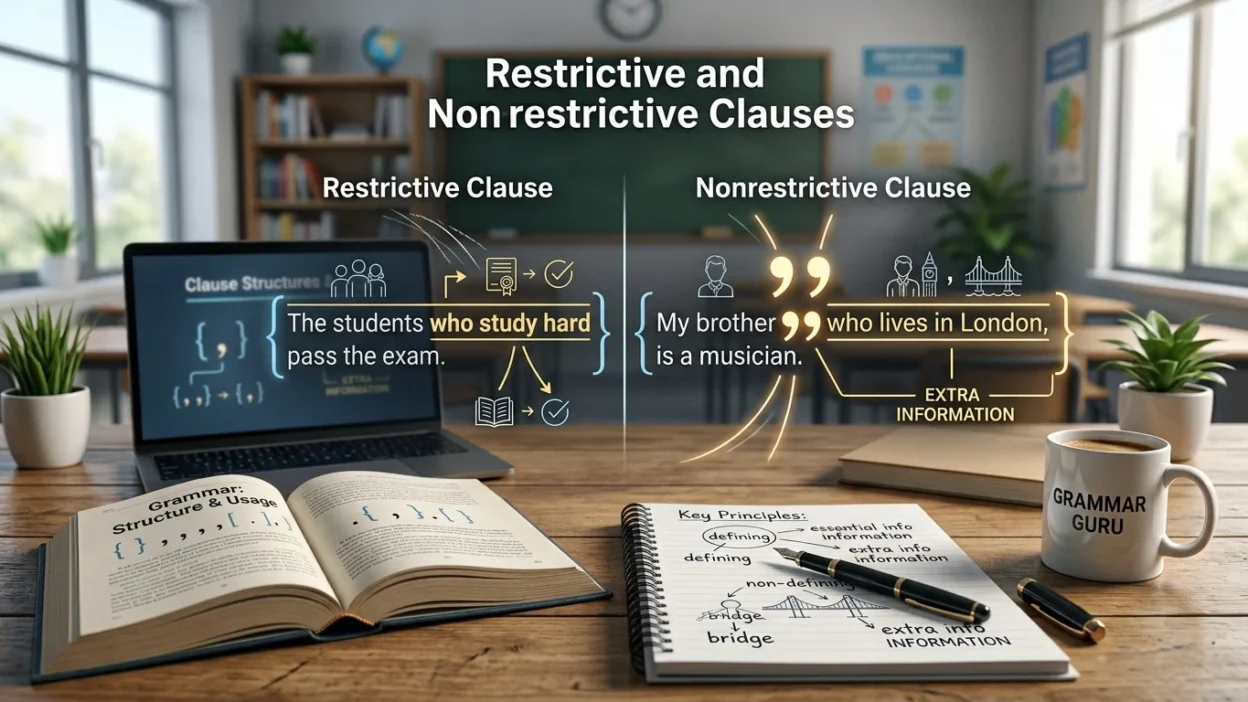
Restrictive and nonrestrictive clauses are two types of adjective clauses that provide information about a noun. The main difference is simple: a restrictive clause is necessary to identify exactly which person or thing you mean, while a nonrestrictive clause adds extra information that can be removed without changing the basic meaning. Punctuation also helps show the difference. Restrictive clauses normally do not use commas, while nonrestrictive clauses are set off with commas.
Understanding this distinction can make your writing clearer and more precise. It is especially important when using relative pronouns such as who, which and that. For students and ESL learners, the comma rule can seem confusing at first, but the meaning based approach makes it much easier. Once you ask whether the information is essential or simply additional, choosing the correct clause becomes much more natural.
Quick Answer: Restrictive vs Nonrestrictive Clauses
A restrictive clause gives essential information needed to identify a noun and usually does not use commas. A nonrestrictive clause gives extra, nonessential information and is separated by commas. In American English, that is commonly used in restrictive clauses, while which can introduce nonrestrictive clauses.
Why Do People Confuse Restrictive and Nonrestrictive Clauses?
People often confuse these clauses because both can describe or provide information about a noun.
For example:
- The students who studied passed the exam.
- The students, who studied, passed the exam.
The words are almost identical, but the commas change the meaning.
In the first sentence, who studied identifies which students passed. It is restrictive.
In the second sentence, who studied is extra information. The sentence suggests that the students had already been identified and that they studied.
The most important question is:
Is the information necessary to identify the noun, or is it simply additional information?
If it is necessary, use a restrictive clause. If it is extra, use a nonrestrictive clause.
What Is a Restrictive Clause?
A restrictive clause is a relative clause that provides information essential to identifying the noun it modifies.
Because the information is essential, removing the clause changes the intended meaning.
Restrictive clauses are also called essential clauses or defining relative clauses.
Examples of Restrictive Clauses
The woman who lives next door is a doctor.
The clause who lives next door tells us which woman we mean.
Without it:
The woman is a doctor.
The meaning becomes less specific.
Another example:
I like books that teach practical skills.
The restrictive clause identifies the type of books the speaker likes. It does not mean all books.
Do Restrictive Clauses Use Commas?
Normally, no.
A restrictive clause is closely connected to the noun it identifies, so commas are not normally used.
Examples:
- The car that has a broken window belongs to Tom.
- Students who arrive late must wait outside.
- The restaurant that we visited yesterday was excellent.
- The phone which I bought last week is already broken.
In American English, that is especially common in restrictive clauses.
What Is a Nonrestrictive Clause?
A nonrestrictive clause gives additional information about a noun that is already sufficiently identified.
It is also called a nonessential clause or nondefining relative clause.
Because the information is extra, it can usually be removed without changing which person or thing the sentence refers to.
Examples of Nonrestrictive Clauses
My brother, who lives in London, is visiting us.
The phrase my brother already identifies the person.
The clause who lives in London simply gives us additional information.
You could remove it:
My brother is visiting us.
The basic reference remains the same.
Do Nonrestrictive Clauses Use Commas?
Yes.
A nonrestrictive clause is normally separated from the main sentence with commas.
Examples:
- My car, which is ten years old, still runs well.
- Sarah, who works at the hospital, called me yesterday.
- Paris, which is the capital of France, attracts millions of visitors.
- My laptop, which I bought last year, needs a new battery.
The commas signal that the information is parenthetical or additional.
Restrictive vs Nonrestrictive Clauses: Comparison Table
| Feature | Restrictive Clause | Nonrestrictive Clause |
|---|---|---|
| Main purpose | Identifies or limits the noun | Adds extra information |
| Also called | Essential/defining clause | Nonessential/nondefining clause |
| Necessary to meaning? | Yes | No |
| Commas | Usually no | Yes |
| Common relative words | who, that, which | who, which |
| Can “that” be used? | Yes, commonly in American English | No |
| Example | The students who studied passed. | The students, who studied, passed. |
| Removing the clause | Can change the meaning | Usually does not change the reference |
When Should You Use a Restrictive Clause?
Use a restrictive clause when the reader needs the information to know exactly which person, place, thing, or group you mean.
Use It to Identify a Specific Person
The employee who answered the phone was very helpful.
There may be several employees. The clause identifies one of them.
Use It to Identify a Specific Thing
The dress that I bought yesterday is blue.
The speaker is identifying a particular dress.
Use It to Limit a Group
People who exercise regularly may improve their fitness.
The clause limits the meaning to a particular group of people.
When Should You Use a Nonrestrictive Clause?
Use a nonrestrictive clause when the noun is already clearly identified and you simply want to provide more information.
Add Extra Information About a Person
David, who is my oldest friend, lives nearby.
The name David already identifies the person.
Add Extra Information About a Place
London, which is famous for its history, attracts many visitors.
London is already clearly identified.
Add Extra Information About an Object
My new phone, which has a large screen, is easy to use.
The phrase my new phone already identifies the object.
12 Examples of Restrictive and Nonrestrictive Clauses
1. Restrictive
The students who completed the assignment received extra credit.
Only the students who completed the assignment received extra credit.
2. Nonrestrictive
The students, who completed the assignment, received extra credit.
Here, the sentence presents the students as an already identified group and adds that they completed the assignment.
3. Restrictive
The dog that has a red collar belongs to my neighbor.
The clause identifies which dog.
4. Nonrestrictive
Max, who has a red collar, belongs to my neighbor.
Max is already identified by name.
5. Restrictive
The books that are on the table are mine.
The clause identifies which books.
6. Nonrestrictive
These books, which are on the table, are mine.
The books are already identified as these books.
7. Restrictive
The teacher who taught me English moved to Canada.
The clause identifies which teacher.
8. Nonrestrictive
Mr. Brown, who taught me English, moved to Canada.
The name already identifies the teacher.
9. Restrictive
I want a phone that has a good camera.
The clause limits the type of phone wanted.
10. Nonrestrictive
My phone, which has a good camera, is quite expensive.
The phone is already identified.
11. Restrictive
The house that has a blue door is for sale.
The clause identifies the house.
12. Nonrestrictive
Our house, which has a blue door, is for sale.
Our house already identifies the property.
Common Mistakes With Restrictive and Nonrestrictive Clauses
Mistake 1: Adding Commas to a Restrictive Clause
Incorrect:
The students, who studied hard, passed the test.
If the intended meaning is that only the students who studied hard passed, the commas should be removed.
Correct:
The students who studied hard passed the test.
Mistake 2: Removing Necessary Information
Consider:
The employee who handles payroll is absent.
The clause identifies which employee is absent.
Removing it gives:
The employee is absent.
That may refer to a different or less specific person.
Mistake 3: Forgetting Commas With Nonrestrictive Clauses
Incorrect:
My sister who lives in Karachi is a teacher.
If you have only one sister and who lives in Karachi is additional information, commas are needed:
My sister, who lives in Karachi, is a teacher.
However, if you have multiple sisters and the clause identifies which sister you mean, no commas are appropriate:
My sister who lives in Karachi is a teacher.
Mistake 4: Using “That” in a Nonrestrictive Clause
In standard edited American English, avoid:
My car, that is very old, still works.
Use:
My car, which is very old, still works.
That is generally used for restrictive relative clauses, not nonrestrictive ones.
Mistake 5: Thinking Every “Who” Clause Is Nonrestrictive
The word who does not automatically make a clause nonrestrictive.
Compare:
The woman who called me is my manager.
Restrictive.
Maria, who called me, is my manager.
Nonrestrictive.
The meaning and punctuation determine the type.
What Is the Easy Memory Trick?
Think of restrictive = restrict.
A restrictive clause restricts or narrows down the noun.
The students who studied passed.
Which students? The ones who studied.
Think of nonrestrictive = extra.
A nonrestrictive clause gives information that you could remove.
Maria, who studied all night, passed.
Who is Maria? We already know. The clause simply adds information.
A useful shortcut is:
Essential information = no commas.
Extra information = commas.
American vs British English
The basic distinction between restrictive and nonrestrictive clauses is the same in American and British English.
However, there are some differences in style and relative-pronoun preferences.
American English commonly uses that for restrictive clauses:
The book that I bought was expensive.
British English also uses that, as well as which, in restrictive clauses:
The book which I bought was expensive.
In formal American English, which is strongly associated with nonrestrictive clauses when commas are used:
The book, which I bought yesterday, was expensive.
British usage can be somewhat more flexible about which in restrictive clauses.
The safest approach for learners is to focus first on the meaning and punctuation rather than trying to memorize every regional preference.
Similar Words and Related Grammar Terms
Restrictive and nonrestrictive clauses are closely related to several other grammar terms.
Relative Clause
A relative clause is a clause that modifies a noun or noun phrase.
Example:
The man who lives next door is friendly.
Defining Relative Clause
A defining relative clause is another name for a restrictive clause.
It provides information needed to identify the noun.
Nondefining Relative Clause
A nondefining relative clause is another name for a nonrestrictive clause.
It provides additional information.
Essential Clause
An essential clause is another term for a restrictive clause.
Nonessential Clause
A nonessential clause is another term for a nonrestrictive clause.
Relative Pronoun
Common relative pronouns include:
- who
- whom
- whose
- which
- that
For example:
The person who called left a message.
The book that I borrowed is interesting.
The car, which is very old, still works.
Final Verdict: Restrictive or Nonrestrictive?
The key difference is whether the clause is necessary to identify the noun.
Use a restrictive clause when the information narrows down or identifies the noun. Do not normally use commas.
The students who studied passed.
Use a nonrestrictive clause when the noun is already identified and the clause simply adds information. Use commas.
Maria, who studied hard, passed.
When you are unsure, remove the clause and ask:
Does the sentence still clearly refer to the same person, place, thing, or group?
If yes, the clause may be nonrestrictive.
If removing it changes which noun you mean, the clause is likely restrictive.
Frequently Asked Questions
What is the difference between restrictive and nonrestrictive clauses?
A restrictive clause gives essential information that identifies or limits a noun. A nonrestrictive clause adds extra information that is not necessary for identifying the noun.
Do restrictive clauses need commas?
Usually, no. Restrictive clauses are normally written without commas because their information is essential to the meaning.
Do nonrestrictive clauses need commas?
Yes. Nonrestrictive clauses are normally separated from the rest of the sentence with commas.
Can “that” be used in a nonrestrictive clause?
Generally, no in standard edited English. That is commonly used in restrictive clauses, while which or who is normally used in nonrestrictive clauses.
What is another name for a restrictive clause?
A restrictive clause can also be called an essential clause or defining relative clause.
What is another name for a nonrestrictive clause?
A nonrestrictive clause can also be called a nonessential clause or nondefining relative clause.
Can “which” be used in a restrictive clause?
Yes. In British English especially, which can be used in restrictive clauses. American English commonly uses that for restrictive clauses, although which can also occur depending on style and context.
How can I quickly identify a nonrestrictive clause?
Look for information that could be removed without changing which person or thing the sentence refers to. Such information is normally set off with commas.
Remember This
Restrictive = essential = no commas.
Nonrestrictive = extra = commas.
Ask yourself one question:
“Does the reader need this information to know exactly which noun I mean?”
If the answer is yes, use a restrictive clause.
If the answer is no, use a nonrestrictive clause.
Conclusion
Restrictive and nonrestrictive clauses both give information about nouns, but they perform different jobs. A restrictive clause identifies or limits the noun, so its information is essential and normally appears without commas. A nonrestrictive clause adds information about an already identified noun, so it is separated with commas.
Once you focus on meaning before punctuation, the difference becomes much easier. Remember that restrictive clauses narrow the meaning, while nonrestrictive clauses simply add information. With practice, you will be able to recognize and use both types naturally in everyday and formal writing.

Aiden Luke is a dream interpretation writer at OpenMeanings.com, exploring dream symbols, meanings, and insights to inspire understanding.