
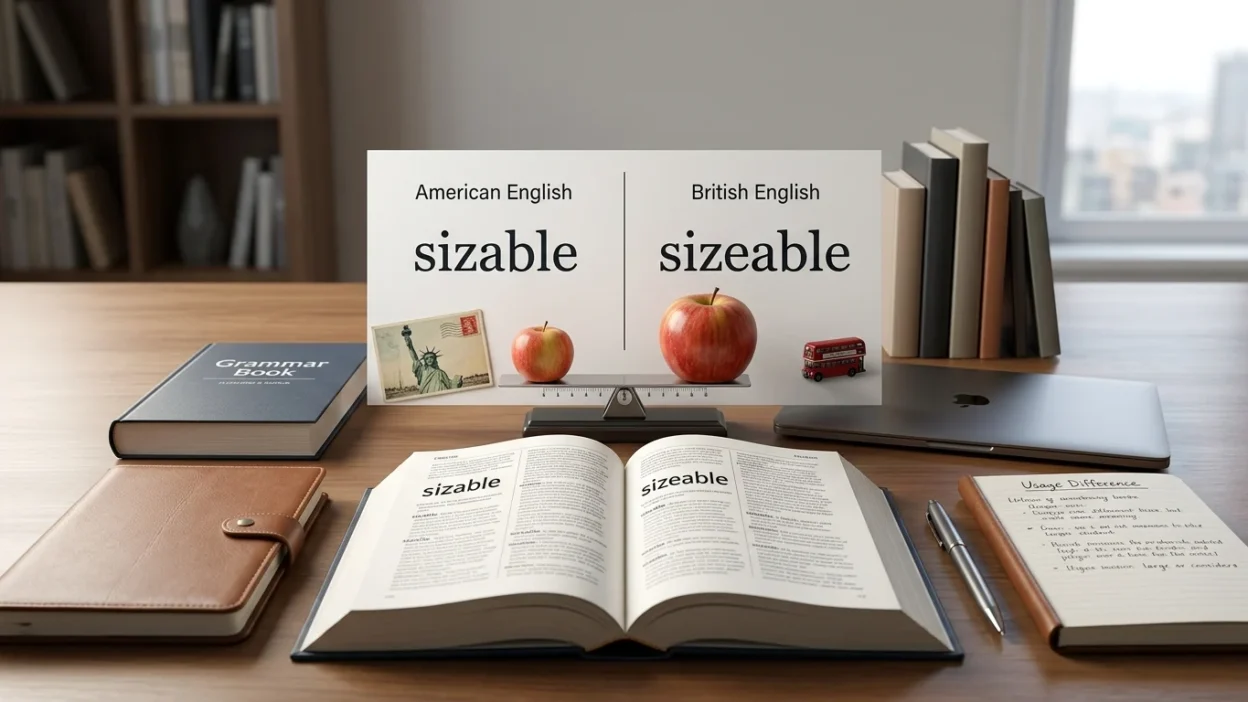
Sizable and sizeable are both correct spellings of the same English adjective. They mean fairly large, considerable or substantial in size or amount. The main difference is regional spelling: sizable is the standard spelling in American English, while sizeable is more common in British English and other varieties that generally follow British spelling conventions.
If you are learning English, this is an easy distinction once you know the spelling pattern. Both forms are pronounced the same way and can be used in the same grammatical situations. For example you can say, “The company made a sizable profit” or “The company made a sizeable profit.” The meaning does not change. Your choice mainly depends on the variety of English you are writing in and the style you want to follow.
Quick Answer: Sizable or Sizeable?
Sizable and sizeable are both correct. They mean “fairly large” or “considerable.” Sizable is preferred in American English, while sizeable is more common in British English. The two words have the same pronunciation, meaning, and grammatical function.
Why Do People Confuse Sizable and Sizeable?
People confuse these words because they are simply two spellings of the same adjective.
The difference comes from the way English spelling developed in different regions.
The word is formed from size + -able, which can make the spelling seem confusing. Some writers naturally expect sizeable, while others follow the American spelling sizable.
There is no difference in meaning.
Compare:
The project requires a sizable investment.
The project requires a sizeable investment.
Both sentences mean that the investment is fairly large.
The important thing to remember is that neither spelling is incorrect. The preferred form depends mainly on the variety of English being used.
What Does “Sizable” Mean?
Sizable is an adjective meaning fairly large, considerable, substantial, or significant in size or amount.
It can describe physical size:
They bought a sizable house.
It can also describe an amount, number, or degree:
The company made a sizable profit.
A sizable number of people attended the event.
The word does not necessarily mean extremely large. It usually suggests that something is noticeably or significantly large.
Sizable in a Sentence
Here are some natural examples:
- We received a sizable donation.
- She has a sizable collection of books.
- The company has a sizable customer base.
- They live in a sizable apartment.
- The project requires a sizable budget.
In all these examples, sizable means relatively large or considerable.
What Does “Sizeable” Mean?
Sizeable has exactly the same meaning as sizable.
It is also an adjective meaning fairly large, considerable, or substantial.
For example:
The company has a sizeable market share.
This means the company’s share of the market is fairly large.
You can replace sizeable with sizable without changing the basic meaning:
The company has a sizable market share.
The spelling changes, but the meaning remains the same.
Sizable vs Sizeable: Comparison Table
| Feature | Sizable | Sizeable |
|---|---|---|
| Meaning | Fairly large or considerable | Fairly large or considerable |
| Part of speech | Adjective | Adjective |
| Pronunciation | Same | Same |
| American English | More common | Less common |
| British English | Less common | More common |
| Meaning difference | None | None |
| Example | A sizable amount | A sizeable amount |
When Should You Use “Sizable”?
Use sizable when writing in American English, especially if you want your spelling to match common American usage.
Examples include:
The company has a sizable advantage.
She received a sizable inheritance.
There was a sizable increase in sales.
If you are writing for an American audience, sizable is generally the more natural choice.
When Should You Use “Sizeable”?
Use sizeable when writing in British English or when following a spelling style that prefers British conventions.
Examples:
The charity received a sizeable donation.
The business has a sizeable customer base.
There was a sizeable increase in demand.
For British-oriented writing, sizeable is a natural choice.
12 Examples of Sizable and Sizeable
1. Sizable
The company made a sizable profit last year.
2. Sizeable
The company made a sizeable profit last year.
Both sentences mean the same thing.
3. Sizable
We need a sizable amount of money to complete the project.
4. Sizeable
We need a sizeable amount of money to complete the project.
5. Sizable
She owns a sizable collection of paintings.
6. Sizeable
She owns a sizeable collection of paintings.
7. Sizable
The restaurant has a sizable dining area.
8. Sizeable
The restaurant has a sizeable dining area.
9. Sizable
A sizable number of students joined the program.
10. Sizeable
A sizeable number of students joined the program.
11. Sizable
The organization received a sizable donation.
12. Sizeable
The organization received a sizeable donation.
Notice that changing sizable to sizeable does not change the meaning of any sentence.
Common Mistakes With Sizable and Sizeable
Mistake 1: Thinking One Spelling Is Always Wrong
Some writers believe that sizable or sizeable must be incorrect.
That is not the case.
Both are established English spellings.
Mistake 2: Assuming They Have Different Meanings
They do not.
Both words mean fairly large, substantial, or considerable.
Mistake 3: Mixing Spelling Styles
If you are writing an American English document, you may want to consistently use American spellings such as sizable.
If you are writing in British English, sizeable may fit better with your chosen spelling conventions.
Consistency is more important than treating one form as universally correct.
Mistake 4: Pronouncing Them Differently
The two spellings have the same standard pronunciation.
The extra e in sizeable does not create a different pronunciation.
Mistake 5: Using “Sizable” to Mean “Extremely Large”
Sizable usually means fairly large or considerable. It does not necessarily mean enormous.
For example:
The house has a sizable garden.
This tells us that the garden is fairly large, but it does not necessarily mean that the garden is huge.
What Is the Easy Memory Trick?
Think of the two forms as one word with two regional spellings.
American English → sizable
British English → sizeable
A simple memory trick is:
US: size + able → sizable
UK: size + e + able → sizeable
You do not need to memorize a difference in meaning because there isn’t one.
American vs British English
The main difference between sizable and sizeable is regional preference.
Sizable is the more common American English spelling.
Sizeable is more common in British English and is also used in other varieties influenced by British spelling conventions.
This difference is similar to other American and British spelling variations, such as:
- color / colour
- favorite / favourite
- organize / organise
- center / centre
However, the spelling preference can vary by publication, dictionary, organization, and regional style guide.
If you are writing for an American audience, sizable is a straightforward choice.
If you are writing for a British audience, sizeable is generally more appropriate.
Similar Words to Sizable and Sizeable
Several words have similar meanings.
Large
Means greater than average in size or amount.
They bought a large house.
Considerable
Means fairly large in amount, degree, or importance.
The project requires considerable investment.
Substantial
Means large enough to be important or noticeable.
The company experienced substantial growth.
Significant
Means important or large enough to have an effect.
There was a significant increase in demand.
Sizeable
The British spelling of sizable.
The business has a sizeable customer base.
Sizable
The American spelling of sizeable.
The business has a sizable customer base.
Final Verdict: Sizable or Sizeable?
Sizable and sizeable are both correct.
They have the same meaning, pronunciation and grammatical function.
The main distinction is spelling preference:
- Sizable → more common in American English
- Sizeable → more common in British English
If you are writing for an American audience, choose sizable.
If you are writing for a British audience, choose sizeable.
Most importantly, do not assume that one spelling is grammatically wrong. Both forms are accepted English.
Frequently Asked Questions
Is “sizable” or “sizeable” correct?
Both are correct spellings. Sizable is more common in American English, while sizeable is more common in British English.
Does sizable mean the same as sizeable?
Yes. Sizable and sizeable have the same meaning: fairly large, considerable, or substantial.
Is “sizable” American or British?
Sizable is the more common American English spelling.
Is “sizeable” British English?
Yes. Sizeable is the more common British English spelling, although both forms can be found in different varieties and publications.
How do you pronounce sizable and sizeable?
They are normally pronounced the same way. The spelling difference does not create a difference in standard pronunciation.
Is sizable a formal word?
Yes. Sizable is a standard adjective and can be used in both everyday and formal writing.
Can I use sizable and sizeable interchangeably?
Yes, in terms of meaning and grammar. However, it is better to choose the spelling that matches the English variety and style you are using.
What is the opposite of sizable?
Depending on the context, possible opposites include small, tiny, limited, minor, or insignificant.
Remember This
Sizable = American English preference.
Sizeable = British English preference.
Both mean fairly large or considerable.
The extra e changes the spelling, not the meaning.
Conclusion
The choice between sizable and sizeable is mainly a matter of regional spelling. Both words are correct, both mean “fairly large” or “considerable,” and both function as adjectives. The spelling you choose should depend on the variety of English you are using and the style you want to maintain.
For American English, sizable is generally the better choice. For British English, sizeable is generally more natural. Once you remember this regional difference, you can use either form confidently without worrying that you are changing the meaning of your sentence.